Fez Travel Guide for Australians: The Ancient Soul of Morocco (2026)
Fez is the oldest imperial city in Morocco and home to the world's oldest university. A medieval labyrinth of 9,000 alleyways, world-class tanneries, and living Islamic architecture — here's everything Australians need to know before visiting.
Introduction — The City That Time Forgot
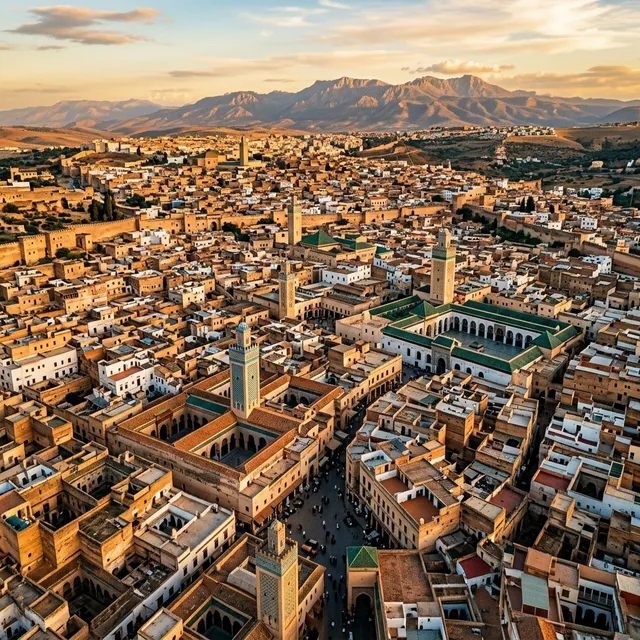
There is a moment every visitor to Fez experiences, usually within the first ten minutes of entering the medina through the blue gate of Bab Bou Jeloud. The noise hits first — the hammering of coppersmiths, the bray of a donkey, the call to prayer echoing from a dozen minarets at once. Then the smell — leather and spices and fresh bread and something ancient you cannot name. Then the realisation: this is not a museum. This is a living city. And it has looked like this for a thousand years.
Fez is the oldest of Morocco’s four imperial cities, founded in 789 CE by Idris I on the banks of the Fez River. It was home to the world’s first university — Al-Qarawiyyin, founded in 859 — long before Oxford, the Sorbonne, or any European institution of learning existed. By 1170 CE, it was the largest city on Earth. Today, its medieval medina is a UNESCO World Heritage Site containing the largest car-free urban area in the world: 9,000 alleyways, 800+ monuments, and a population of 150,000 people living exactly as their ancestors did, in the same buildings, practising the same crafts, in the same labyrinthine streets.
For Australian travellers, Fez is the most intense and most rewarding city in Morocco. Nothing will prepare you for it — and nothing will match it.
Quick Facts: Fez at a Glance
| 🏙️ Founded | 789 CE by Idris I (Idrisid dynasty) |
| 👥 Population | ~1.26 million (2024 census) — second largest city in Morocco |
| 📍 Location | Northern inland Morocco, northwest of the Atlas Mountains |
| 🏛️ UNESCO | Medina of Fez (Fes el-Bali) listed 1981 — first in Morocco |
| 🎓 Claim to fame | Home to Al-Qarawiyyin — the world’s oldest continuously operating university (founded 859 CE) |
| 🌡️ Climate | Continental — hot summers (up to 40°C), mild winters (8–15°C) |
| ✈️ Getting here | Fez-Saïss Airport (FEZ) — via Casablanca (40 min flight) or train from Casa (3.5 hrs) |
| 💰 Budget | Mid-range: 800–1,500 MAD/day (130–240 AUD) incl. accommodation, food & entry fees |
| 🇦🇺 For Australians | No visa required — passport valid 6+ months, free entry |
The Three Parts of Fez
Unlike Marrakech (one medina) or Rabat (one compact historic core), Fez is divided into three distinct worlds — understanding this makes navigating the city much easier.
Fes el-Bali (Old Fez) — Founded 9th century. The UNESCO-listed medieval medina, the largest car-free urban zone in the world. This is where you will spend most of your time: 9,000 alleyways, 10,000+ workshops, the tanneries, Al-Qarawiyyin, the madrasas, and the souks. Donkeys are the only transport permitted inside.
Fes el-Jdid (New Fez) — Founded 13th century by the Marinid dynasty. Home to the Royal Palace (not open to the public, but the golden gates are magnificent), the former Mellah (Jewish quarter), and the old Jewish cemetery. “New” is relative — this district is 700 years old.
Ville Nouvelle (French New City) — Built in the 20th century during the French Protectorate. Modern hotels, restaurants, and the train station. Most visitors use it only to sleep and eat dinner.
Top Attractions
1. Chouara Tannery — The Icon of Fez
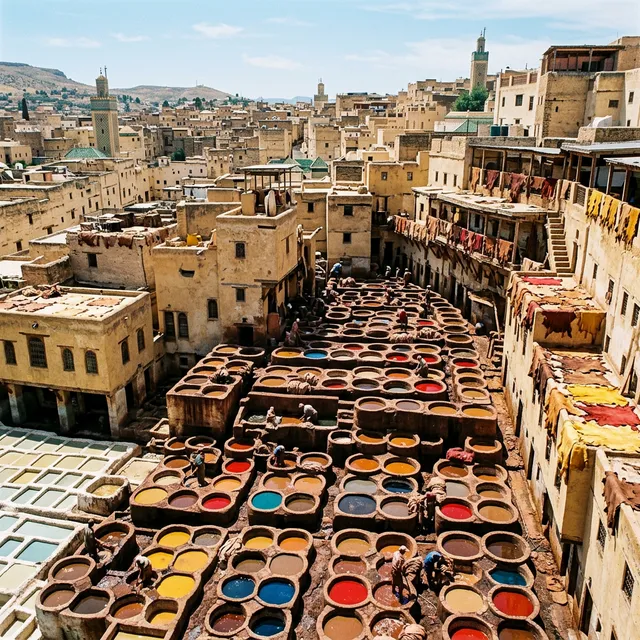
The image you have seen a hundred times — circular stone vats filled with natural dyes in vivid saffron, turquoise, poppy red, and white, surrounded by workers waist-deep in liquid — is real, and it is right here. The Chouara Tannery has operated continuously since the 11th century, using techniques unchanged since the Marinid era: pigeon dung to soften the leather, natural plant dyes for colour.
Access is through the surrounding leather shops, which give you a free terrace view in exchange for politely browsing their goods. You’ll be handed a sprig of fresh mint on entry — you’ll understand why once you’re upstairs.
Practical tip: Visit in the morning (9–11am) when the vats are full of colour and workers are most active. The shops will invite you in — you’re not obligated to buy anything, but the leather goods are genuinely excellent and fairly priced compared to Marrakech.
2. Al-Qarawiyyin Mosque & University
Founded in 859 CE by Fatima al-Fihri — a woman — Al-Qarawiyyin is recognised by UNESCO and the Guinness World Records as the world’s oldest continuously operating university. It predates Oxford (1096) by over two centuries. Scholars including Ibn Khaldun, Ibn Battuta, and Pope Sylvester II (the first French pope) studied here.
Non-Muslims cannot enter the mosque itself, but the exterior courtyard glimpsed through ornate doors, and the surrounding streets thick with students and scholars, give a powerful sense of the institution’s living weight. The adjacent Attarine Medersa (theological school) is open to visitors and gives the best view into the courtyard.
3. Bou Inania Medersa
The most spectacular Islamic architecture you’ll see in Fez — and possibly in Morocco. Built in the 14th century by Marinid Sultan Bou Inan, this theological school is a masterpiece of zellige tilework, carved cedarwood, and chiselled plaster. Three different artistic traditions meet at exactly the height of a man: the lower walls covered in geometric zellige mosaic, the middle band carved in Arabic script, the upper walls and ceiling in intricate arabesque plasterwork.
Entry fee: ~70 MAD (approx. 11 AUD). Worth every dirham.
4. Bab Bou Jeloud — The Blue Gate
The iconic entrance to Fes el-Bali, built in 1913 by the French. It is one of the most photographed gates in Morocco: the exterior faces the city in blue (colour of Fez), the interior faces the medina in green (colour of Islam). Arrive at golden hour for the best photographs — the light turns the intricate faïence tilework extraordinary.
Just inside the gate: the Talaa Kebira, the medina’s main artery, descending steeply into the heart of the old city. Your adventure starts here.
5. Nejjarine Museum of Wooden Arts & Crafts
Housed in an 18th-century caravanserai (merchant inn) that has been immaculately restored, the Nejjarine Museum is the most beautiful building in Fez that most visitors overlook. Three floors of extraordinary carved cedarwood artefacts — doors, furniture, musical instruments, tools — surround a central courtyard of staggering geometric precision. The rooftop café has the best view of the medina’s roofscape in the city.
National Geographic calls it “the finest museum in Morocco.” I agree. Entry is ~20 MAD (3 AUD).
6. Dar Batha Palace & Museum
A 19th-century Andalusian-Moroccan palace housing the region’s finest collection of Moroccan arts and crafts — zellige tilework, carved plasterwork, embroidered textiles, pottery, and manuscripts. The Andalusian garden at its heart is one of Fez’s most peaceful spaces: orange trees, roses, and a central fountain away from the medina’s noise.
Good to know for seniors: Dar Batha has level access and is significantly less physically demanding than the medina. A good first stop before plunging into the alleyways.
7. Marinid Tombs & North Viewpoint
A 15-minute walk uphill from Bab Bou Jeloud brings you to the ruined Marinid Tombs — 14th-century royal mausoleums now inhabited by storks — and the most famous viewpoint over Fez el-Bali. At sunrise and sunset, the medina stretches below you like a textbook of Islamic architecture: 10,000 rooftops, a forest of minarets, the Atlas Mountains on the horizon.
This is the photograph. Arrive 30 minutes before sunset.
8. Royal Palace Gates — Fes el-Jdid
The Dar al-Makhzen is one of the largest royal palaces in the world — an 80-hectare compound still used by King Mohammed VI. The palace itself is not open to visitors, but its seven monumental golden brass gates are among the most spectacular examples of Moroccan craftsmanship in existence. The detailing in the brass — thousands of hand-hammered patterns — took master craftsmen years to complete.
Photography tip: Morning light hits the gates perfectly. The square in front is usually quiet before 9am.
The Fez Medina — Practical Survival Guide
The medina is not a tourist attraction you walk around. It is a functioning medieval city in which you are a guest. Here’s how to navigate it with confidence:
Getting oriented: The medina is shaped like a bowl. Walking downhill means going deeper in; walking uphill means coming out. The main artery — Talaa Kebira — connects Bab Bou Jeloud (the Blue Gate) to Al-Qarawiyyin. If completely lost, look for the minaret of Al-Qarawiyyin and walk toward it.
On guides: On Day 1, hire an official licensed guide from your riad or the tourist office near Bab Bou Jeloud. Cost: 350–450 MAD (~55–70 AUD) for a half-day. This is not a luxury — the medina has no reliable GPS signal, street signs are often in Arabic only, and many of the most spectacular buildings are invisible from outside. A good guide knows which doors lead to wonders.
On touts: If someone offers to show you the tanneries “for free,” they will take you through their family’s leather shop first. This is fine — just know it going in. Smile, look, buy if you like, leave if you don’t. No one will be rude if you decline politely.
On physical fitness: The medina involves steep hills and uneven cobblestones. For senior travellers or those with mobility issues: hire a guide who can plan a flatter route, start early before heat builds, and pace yourself. Most of the major sites are accessible without extreme exertion.
Donkey right-of-way: If you hear “Balek! Balek!” (Move! Move!) behind you, step immediately into a doorway. A loaded donkey has the right of way, always.
Where to Stay
The only correct answer in Fez is a riad inside the medina. Staying in the Ville Nouvelle and day-tripping into the old city is like visiting Sydney and sleeping in Parramatta.
A riad is a traditional Moroccan house built around a central courtyard — from the outside, a nondescript door in an alley wall. Inside: fountains, orange trees, carved plasterwork ceilings, and absolute silence despite being metres from the medina’s chaos.
| Budget | What to Expect | Approx. Price |
|---|---|---|
| Budget | Simple riad, shared breakfast | 300–500 MAD/night (50–80 AUD) |
| Mid-range | Restored riad, en-suite, rooftop terrace | 600–1,200 MAD/night (95–190 AUD) |
| Luxury | Boutique riad, pool, hammam, 5-star service | 1,500–3,500 MAD/night (240–560 AUD) |
Recommended neighbourhood: Stay near Bab Bou Jeloud (the Blue Gate area) for easiest medina access and proximity to restaurants. Avoid riads deep in the medina for your first visit — finding your way back at night takes experience.
Food & Drink — What to Eat in Fez
Fez is widely considered to have the finest traditional cuisine in Morocco. The Fassi (Fez people) take their food extremely seriously — here are the dishes you must try:
Bastilla (B’stilla) — Fez’s signature dish and Morocco’s most complex: a crispy warqa pastry pie filled with slow-cooked pigeon (or chicken), almonds, eggs, and saffron, dusted with cinnamon and icing sugar. Sweet and savoury simultaneously — unlike anything in Australian cuisine. Order it 24 hours in advance at a good restaurant.
Harira — The rich tomato, lentil, and lamb soup served everywhere in Morocco, but Fez’s version — thick with chickpeas and finished with a squeeze of lemon — is the standard against which all others are measured. ~15 MAD a bowl from medina stalls.
Mrouzia — A Marinid-era lamb tagine with honey, raisins, and ras el-hanout (a blend of 27 spices). Slow-cooked for hours. One of the oldest recipes in Moroccan culinary history.
Medfouna — A stuffed bread filled with minced meat, onions, and herbs, baked in a wood oven. Known as “Berber pizza.” Best eaten hot from a medina bakery for ~10 MAD.
Where to eat: For a proper Fassi meal, book a table at a riad restaurant inside the medina — Dar Roumana, Riad Rcif, or ask your riad for their recommendation. For street food, Bou Jeloud Square and the souks around it are excellent and completely safe.
Day Trips from Fez
Meknes — 45 Minutes by Train
One of Morocco’s four imperial cities, Meknes is dramatically undervisited compared to Fez and Marrakech. Sultan Moulay Ismail built it as his grand capital in the 17th century — the vast Bab Mansour gate is arguably the finest monumental gate in all of Morocco, bigger and more ornate than anything in Fez or Marrakech. The medina is relaxed, the people friendly, and the absence of tourist crowds is a genuine relief after Fez’s intensity.
Combine with: Volubilis Roman ruins (30 min from Meknes) — the best-preserved Roman mosaics in North Africa, a UNESCO World Heritage Site. Visit Volubilis first (morning), then Meknes (afternoon), return to Fez by train in the evening.
Ifrane — 1 Hour by Bus
Known as “the Switzerland of Morocco,” Ifrane is a bizarre and wonderful mountain town built by the French in a Swiss Alpine style, sitting at 1,665m altitude in the Middle Atlas. In winter it snows heavily. In summer it’s 15°C cooler than Fez. Cedar forests surrounding the town are home to the last wild population of Barbary macaques in Morocco — monkeys you can watch and photograph from the roadside.
Fez for Australian Senior Travellers
Fez is more physically demanding than Rabat or Essaouira — the medina’s cobblestones and hills require comfortable shoes and some stamina. That said, with the right approach it is completely accessible:
- Stay near Bab Bou Jeloud — the flattest entry point to the medina
- Use a private guide — they can plan routes appropriate for your pace
- Visit in spring or autumn — summer heat in this inland city is brutal (38–42°C)
- Riads have rooftop terraces — a shaded retreat whenever you need to rest
- Dar Batha Museum has level access and is excellent without physical strain
- The Marinid Tombs viewpoint requires a 15-minute uphill walk — but the view is worth it and taxis can take you partway
Practical Tips for Australians
- Best months to visit: March–May or September–November. Avoid July–August (extreme heat).
- Getting there: Train from Casablanca (3.5 hrs, ~120 MAD / 19 AUD). Fly Casablanca–Fez (~40 min, from 300 MAD). CTM bus from Marrakech (6–7 hrs, ~200 MAD).
- Transport in Fez: Petit taxis (small red taxis) for moving between Bab Bou Jeloud, the Ville Nouvelle, and the train station. Always agree on price before getting in, or insist on the meter.
- Wi-Fi & mobile: Medina Wi-Fi is unreliable. Download offline maps (Maps.me or Google Maps offline) before entering. Buy a Maroc Telecom SIM (~50 MAD) at the airport.
- Dress code: Conservative dress is respectful and expected inside the medina — shoulders and knees covered for both men and women. Not legally required, but it makes a genuine difference in how you’re received.
- Photography: Ask before photographing people — Fassi residents are proud and private. Most will say yes with a smile. In the tanneries, photography is freely permitted from the terraces above.
- Bargaining: Expected in souks, unnecessary in riad restaurants and established shops. Start at 40–50% of the asking price and work from there.
- Emergency: 190 (Police), 150 (Ambulance). Australian Embassy is in Rabat: +212 537 67 00 00.
Frequently Asked Questions
Is Fez safe for Australian tourists?
Yes. Fez is safe for tourists. The main risk is getting lost in the medina — which is actually part of the experience. Use a licensed guide for your first day, stay aware of your belongings in crowded souks, and you’ll have no issues.
How many days do I need in Fez?
Allow at least 3 full days: one day with a guide to orient yourself, one day exploring independently, and one day for day trips to Meknes and Volubilis.
What is the best time to visit Fez?
March to May and September to November are ideal — mild temperatures (18–25°C), fewer crowds than summer, and the medina is at its most atmospheric. Avoid July–August when heat in the inland city can exceed 40°C.
How do I get to Fez from Marrakech or Casablanca?
By train: Casablanca to Fez takes about 3.5 hours (ONCF). Marrakech to Fez is 7–8 hours by train or 6 hours by CTM bus via Casablanca. Fez has its own international airport with connections via Casablanca.
Do I need a guide in the Fez medina?
For your first day, yes — a licensed official guide is genuinely worth it. The medina has 9,000+ alleyways and no GPS works reliably inside it. Your riad can arrange one for around 350–450 MAD (approx. 55–70 AUD) for a half day.
Written by Soul — a Moroccan living in Casablanca with 15 years of guiding visitors through the imperial cities. Last updated: March 2026.