Rabat Travel Guide for Australians: The Underrated Capital (2026)
Morocco's capital is the country's most relaxed and elegant city — UNESCO-listed, coastal, and far less touristy than Marrakech. Here's everything Australians need to know.
Introduction
Rabat is Morocco’s best-kept secret — and in 2026, the world is finally catching on. Designated UNESCO World Book Capital for 2026, this elegant coastal city offers everything Marrakech does, minus the crowds, the aggressive selling, and the tourist fatigue. As someone who has lived between Moroccan cities for years, I tell every Australian visitor the same thing: if you want to experience the real rhythm of Moroccan life without the theatre, come to Rabat.
It sits where the Bou Regreg River meets the Atlantic — a city of wide boulevards, royal palaces, ancient kasbahs, and pristine beaches, all within walking distance of each other. The medina is manageable and genuinely charming. The people are relaxed. A modern tram system makes navigation effortless. And in 2026, with the UNESCO World Book Capital designation bringing cultural events, exhibitions and literary festivals throughout the year, there has never been a better time to visit.
Quick Facts: Rabat at a Glance
| 🏙️ Founded | 12th century (Almohad dynasty) |
| 👥 Population | ~1.8 million (city + Salé, 2026) |
| 📍 Location | Atlantic coast, northwestern Morocco |
| 🏛️ UNESCO | World Heritage City (2012) — 4 sites listed |
| 🌟 2026 Special | UNESCO World Book Capital of the Year |
| 🌡️ Climate | Mediterranean — mild winters (avg 16°C), warm summers (avg 28°C) |
| ✈️ From AU | ~22 hrs via Dubai or Doha, connect Casablanca then train (~1.5 hrs) |
| 💰 Currency | Moroccan Dirham — 1 AUD ≈ 6.2 MAD (2026) |
Why Visit Rabat in 2026?
The timing could not be better. Rabat holds the UNESCO World Book Capital title throughout 2026, which means the city is hosting special literary events, international author residencies, book fairs, and cultural exhibitions throughout the year. The National Library has been renovated, the Grand Théâtre de Rabat is in full operation, and two major five-star hotel openings (Four Seasons and Waldorf Astoria) have added world-class accommodation to an already strong hospitality scene.
Beyond the calendar, Rabat rewards visitors who choose it over Marrakech for a simple reason: you get a more authentic Morocco. This is a city where Moroccans actually live and work. The government ministries, the embassies, the universities — they are all here. The medina is not a theme park; it is someone’s neighbourhood.
Top 8 Places to Visit in Rabat
1. 🏰 Kasbah of the Udayas
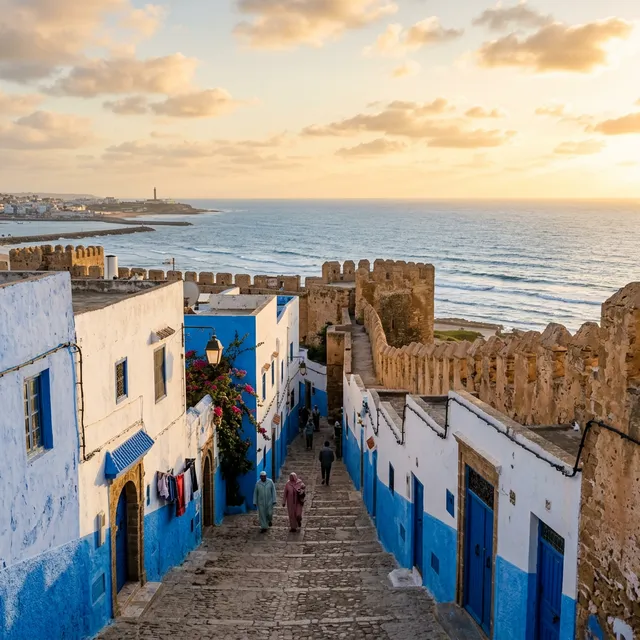
The Kasbah is Rabat’s crown jewel — a 12th-century fortress perched on a cliff at the mouth of the Bou Regreg River, its white-and-blue painted houses spilling down toward the Atlantic. Built by the Almohad dynasty, it served for centuries as a base for Moroccan corsairs who patrolled the Atlantic trade routes.
Wander the Rue Jamaa — the kasbah’s main lane — past indigo-painted doorways and cascading bougainvillea. The Andalusian Gardens at the kasbah’s heart were designed in the 17th century by Moorish exiles from Spain: geometric flowerbeds, orange trees, and fountains that feel like a corner of Granada transported to Africa. End at Café Maure, a terrace café overlooking the river estuary and the ancient walls of Salé across the water — mint tea here is one of life’s perfect moments.
Practical info: Free entry to the kasbah area. Open daily.
2. 🕌 Hassan Tower & Mausoleum of Mohammed V
The Hassan Tower is Rabat’s most iconic landmark — a 44-metre minaret begun in 1195 under Sultan Yacoub al-Mansour, intended to be the tallest in the Islamic world. Construction stopped upon his death and was never completed. What remains is extraordinary: the incomplete tower stands surrounded by 200 columns of the unfinished mosque, all preserved for over 800 years.
Directly opposite stands the Mausoleum of Mohammed V, the ornate resting place of the grandfather of the current king. The interior — open to non-Muslim visitors, unusually — features some of the most spectacular traditional Moroccan craftsmanship you will see anywhere: hand-carved cedarwood, Fez tilework, painted ceilings.
Practical info: Free entry. Allow 45–60 minutes. The combination of the two sites makes for excellent photography, especially in the late afternoon light.
3. ⚱️ Chellah Necropolis
One of Rabat’s most hauntingly beautiful sites, Chellah was first a Roman town (Sala Colonia), then abandoned, then converted into a royal necropolis by the Marinid sultans in the 14th century. Today, the site is a slow-motion ruin of Roman mosaics, Islamic tombs, and tower storks that nest on the ancient minarets.
The atmosphere — particularly at opening time (9am) — is completely different from anywhere else in Morocco. There are no crowds, no hawkers, and no noise except birdsong and the occasional clatter of stork bills from above. Come here to breathe.
Practical info: Entry 70 MAD (~11 AUD). Open daily 8am–6pm (reduced in winter).
4. 🎨 Mohammed VI Museum of Modern & Contemporary Art
Morocco’s finest museum for modern and contemporary art, opened in 2014 and now established as one of the most important cultural institutions in Africa. The permanent collection covers major Moroccan artists of the 20th and 21st centuries — painters, sculptors, and photographers — with international exhibitions rotating throughout the year.
Practical info: Entry 60 MAD (~10 AUD). Closed Tuesdays. Allow 1.5–2 hours.
5. 🛍️ Rabat Medina & Rue des Consuls
Rabat’s medina is the most relaxed in Morocco. The old city is small enough to navigate without a guide and genuinely enjoyable to wander — the vendors are laid-back, prices are fair, and the atmosphere is entirely local rather than tourist-oriented.
Rue des Consuls is the medina’s main antique and craft street, historically the area where foreign diplomats shopped. Today it is lined with dealers selling Rbati rugs (the city’s signature craft — thick, long-pile wool), silverwork, antique jewellery, and traditional clothing.
6. 🎭 Grand Théâtre de Rabat
Designed by the celebrated architect Zaha Hadid and completed in 2022, the Grand Théâtre is a genuine architectural landmark — a wave-shaped white building that seats 1,800 people and is one of the largest performing arts venues in Africa. If there is a performance scheduled during your visit, attending is a genuine experience.
Practical tip: Check the calendar at grandtheatre.ma for current programming.
7. 🚣 Boat Ride to Salé
Just across the Bou Regreg River from Rabat lies the sister city of Salé — older, quieter, and far less visited. Take the traditional wooden flouka boat (5 MAD, 80 Australian cents) from the dock below the kasbah. Salé has its own medina, the beautiful Marinid Sanctuary of Sidi Ahmed El-Mansour, and a completely different atmosphere from Rabat — quieter and more conservative.
8. 🏖️ Plage de Rabat & Corniche
Rabat’s city beach is directly accessible from the city centre — an Atlantic beach stretching north from the Bou Regreg estuary. The water is clean, the swimming is good in summer, and the Corniche — the promenade running along the clifftop — is where Rabatis walk, run, and sit in the evenings. This is everyday Moroccan life in motion.
Best Areas to Stay in Rabat
| Neighbourhood | Character | Best For |
|---|---|---|
| Medina | Historic, authentic, central | Budget travellers wanting immersion |
| Agdal | Modern, residential, green | Mid-range hotels, quiet streets |
| Hay Riad | Upscale, international | Business travellers, luxury hotels |
| Souissi | Leafy diplomatic quarter | Premium and boutique accommodation |
For most Australian visitors: A riad or small hotel inside or adjacent to the medina gives the best balance of location, experience, and value. Expect to pay 400–800 MAD per night (65–130 AUD) for a good mid-range option.
Getting Around Rabat
Rabat’s tramway (tram) is the best way to navigate the city — clean, reliable, and covering all major sites including Hassan Tower, the train station, and the medina. A single journey costs 7 MAD (just over 1 AUD). Petit taxis are widely available for shorter trips; always agree on the fare before you get in, or insist on the meter.
Car rental is not necessary within the city. If you plan day trips to Casablanca (45 min by Al Boraq), Meknes (1.5 hrs by train), or Fez (2.5 hrs by train), the train is always the better option.
What to Eat in Rabat
Rabat has an excellent food scene that most tourists miss, focused on genuine Moroccan cooking rather than tourist-facing restaurants.
- Pastilla au lait — Rabat’s signature sweet pastry, filled with cream and crushed nuts. Find it in any pâtisserie in the medina.
- Grilled sardines — Freshest on the coast. The restaurant row along the Corniche serves the best.
- Harira soup — The rich Moroccan tomato-lamb-chickpea soup, served with dates and msemen (flatbread) at any medina café.
- Restaurant Le Ziryab (inside the kasbah) — Stunning views, genuine Moroccan cuisine at reasonable prices.
Day Trips from Rabat
| Destination | Distance | How to Get There |
|---|---|---|
| Casablanca (Hassan II Mosque) | 45 min | Al Boraq high-speed train |
| Meknes | 1.5 hrs | Regular train |
| Fez | 2.5 hrs | Regular train |
| Moulay Bousselham | 1.5 hrs | Grand taxi |
| Volubilis Roman Ruins | 2 hrs | Day tour or taxi |
Practical Travel Tips for Australians
- Getting there: Fly QatarAirways via Doha or Emirates via Dubai from any major Australian city. Arrive into Casablanca (CMN) and take the train to Rabat (90 minutes, ~55 MAD).
- Language: French is more useful in Rabat than Darija. Most educated Rabatis speak excellent French and some English.
- Money: ATMs on Avenue Mohammed V in the new city dispense dirhams reliably. Carry cash for the medina.
- Dress: Rabat is the most cosmopolitan city in Morocco — women can dress more moderately than in smaller towns, but covering shoulders and knees in the medina is always respectful.
- Safety: Rabat is genuinely one of the safest cities in Morocco. Standard city precautions apply.
Explore our full Morocco Itineraries section for more destination guides.