Essaouira Travel Guide for Australians (2026 Guide)
Essaouira is the most relaxed and authentic medina city in Morocco — whitewashed ramparts, Atlantic wind, fresh seafood, and the legendary Gnawa music festival. A must-visit for Australian travellers.
Introduction
Essaouira is the city every traveller falls in love with and never quite forgets. It is smaller, cooler, and infinitely more relaxed than Marrakech — a walled Atlantic port city where the wind shapes everything: the waves, the music, the kite-surfers carving the sea, and the character of a people who have spent centuries with their face to the ocean.
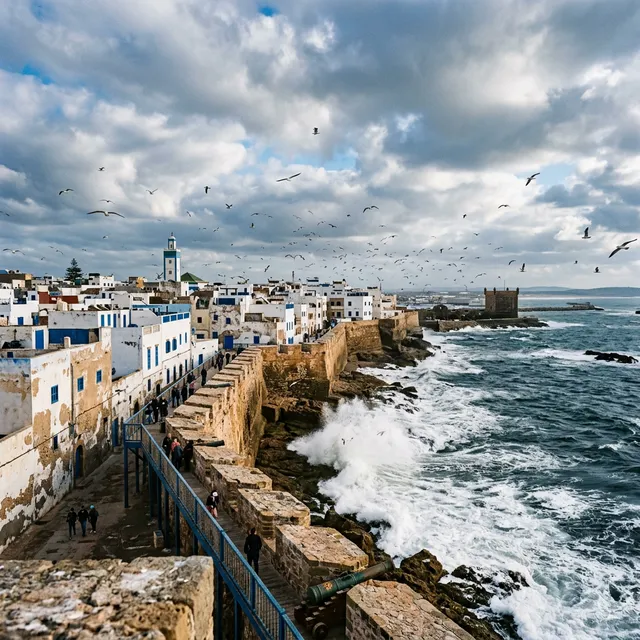
The medina is a UNESCO World Heritage Site, painted in the blue-and-white palette of the Atlantic coast. The ramparts — 18th-century cannon battlements that watch over open ocean — are among the most dramatic in Africa. The souks are genuinely local rather than tourist-facing: woodworkers using thuya root, silversmiths in tiny workshops, musicians playing Gnawa rhythms in unmarked doorways, and fishermen selling the morning catch at the harbour before the restaurants even open.
Every Moroccan I know who works in tourism eventually ends up in Essaouira to breathe. This is the Morocco that existed before the travel industry arrived — and somehow, miraculously, it still does.
Quick Facts: Essaouira at a Glance
| 🏙️ Founded | Portuguese fort 16th century; rebuilt as Moroccan port 18th century |
| 👥 Population | ~77,000 (city) — intimate and human-scale |
| 📍 Location | Atlantic coast, midway between Agadir and Casablanca |
| 🏛️ UNESCO | Medina listed as World Heritage Site (2001) |
| 💨 Nickname | ”Windy City” — Alizée trade winds blow almost daily |
| 🎵 Famous for | Gnawa & World Music Festival (25–27 June 2026) |
| 🌡️ Climate | Cool Atlantic breezes year-round (avg 22°C summer, 15°C winter) |
| ✈️ Getting here | 2.5–3 hrs by bus from Marrakech; 2 hrs from Agadir |
A Brief History of Essaouira
The site of Essaouira has been inhabited since Phoenician times — the offshore island (Île de Mogador) was used as a dye factory producing the legendary purple used in Roman imperial robes. The Portuguese built the first significant fortifications in the 16th century.
The city as it exists today was essentially designed from scratch in 1764–1765 by the French architect Théodore Cornut, commissioned by Sultan Mohammed III. This makes Essaouira unusual among Moroccan medinas — it is a planned city, which explains its rational, navigable grid of streets (unlike the organic labyrinths of Fez or Marrakech).
Under Mohammed III, Essaouira became Morocco’s primary Atlantic trading port, with a large community of European merchants, Jewish traders, and Moroccan merchants living side by side. This cosmopolitan heritage flavours the city to this day.
In the 20th century, Essaouira attracted artists and musicians: Jimi Hendrix famously visited in 1969 (spending time in the nearby village of Diabat), and the city became associated with the Gnawa music tradition that has since gained international recognition.
Top 8 Things to Do in Essaouira
1. 🏰 Walk the Sea Ramparts (Skala de la Ville)
Essaouira’s most dramatic experience: walking the Skala de la Ville, the 18th-century cannon-lined sea ramparts that form the city’s western wall against the Atlantic. The view from the ramparts — cannon barrels pointing at open ocean, the city’s white-and-blue rooftops stretching behind you, the Atlantic crashing on the rocks below — is one of the most evocative scenes in Morocco.
This is where Orson Welles filmed the opening scenes of his 1951 Othello — the same walls, largely unchanged. Enter from the medina side near the main door northward.
Practical info: Free entry. The rampart walk takes 20–30 minutes.
2. 🐟 The Essaouira Harbour
The working fishing harbour is one of the most authentic scenes in any Moroccan city. Blue-painted wooden boats crowd the quays; fishermen in orange overalls unload the morning catch; cats weave through the crowd. The fish market runs in the morning until the catch is sold.
The most famous experience here: choose your fish from the harbour vendors, negotiate a price, and have it cooked fresh on one of the charcoal grills set up along the port wall. This is eating as it should be — honest, fresh, and extraordinarily good value (a full grilled fish plate with bread for 40–80 MAD, 6–13 AUD).
3. 🎵 Gnawa Music in Essaouira
Gnawa is a spiritual music tradition brought to Morocco centuries ago by sub-Saharan African slaves and subsequently absorbed into Moroccan Sufi practice. Its hypnotic rhythms — played on the guenbri (a three-string bass lute) and qraqeb (iron castanets) — are among the most distinctive sounds in world music.
Essaouira is the heartland of Gnawa. You will hear it played spontaneously in the medina, in tea houses, and at the harbourside. The annual Gnawa and World Music Festival (25–27 June 2026) brings the tradition to a global stage — three days of free outdoor concerts on the beach and in the medina squares, drawing 300,000+ attendees including international music fans, world music acts, and Moroccan visitors.
4. 🌿 The Medina Souks & Woodworking Quarter
Essaouira’s medina souks are a genuine pleasure — unhurried, local, and focused on actual crafts rather than tourist trinkets. The city’s signature craft is thuya root woodwork — thuya is an aromatic cedar found only in the Essaouira region, and local artisans have worked it for generations into jewellery boxes, furniture, chess sets, and decorative items. Prices are fair and the quality is outstanding.
The silverwork (traditional Berber jewellery using triangular pendants, amber beads, and engraved silver) is also excellent. The spice and argan oil souk near the main medina entrance sells genuine argan oil (cosmetic and culinary), rose water, and local spices — far cheaper than tourist shops in Marrakech.
5. 🏖️ Essaouira Beach & Kitesurfing
Essaouira’s beach stretches for nearly 10 kilometres south of the medina — a wild, beautiful Atlantic beach backed by sand dunes and argan forest. The consistent Alizée trade winds that make sightseeing uncomfortable in summer make this beach one of Africa’s premier kitesurfing and windsurfing destinations.
Several kitesurf schools offer lessons (beginners’ courses start around 800 MAD / 130 AUD for a half-day). Even non-surfers find the beach extraordinary — the scale, the light, and the drama of seeing kite-surfers carving across Atlantic swells is genuinely spectacular.
6. 🎨 Galerie Damgaard & Essaouira’s Art Scene
The Galerie Frédéric Damgaard (named after the Danish furniture designer who discovered and promoted Essaouira’s naïve artists in the 1980s) is a working gallery on the main medina avenue showcasing the distinctive, colourful, visionary work of local painters. Essaouira has a genuine, internationally recognised art movement — these are not tourist paintings, but collected works that reach galleries in Paris and New York.
7. 🦅 Île de Mogador (Purpuraire Islands)
The two small islands visible from Essaouira harbour were used by Phoenicians for purple dye production, then by Portuguese traders, and are today a protected reserve. The islands are home to one of Morocco’s three colonies of Eleonora’s Falcons — the rare raptor breeds here July–October.
Boat trips to the island are available from the harbour (ask at the quay; trips run when conditions allow).
8. 📚 The Medina Cafés & the Art of Slowing Down
The best thing to do in Essaouira is also the least specific: sit in a medina café with a glass of mint tea, listen to the wind off the ocean, and allow the city to slow you down. The Place Moulay Hassan — the main square — is perfect for this. It opens to the harbour and sets the pace for the whole city: unhurried, open, genuinely welcoming. There is nowhere in Morocco where I feel more relaxed.
Best Accommodation in Essaouira
| Type | Best Area | Price Range (per night) |
|---|---|---|
| Riad in medina | Inside the medina walls | 200–700 MAD (32–115 AUD) |
| Boutique hotel | Near Place Moulay Hassan | 600–1,200 MAD (100–195 AUD) |
| Surf lodge | South of medina, beach area | 400–900 MAD (65–145 AUD) |
| Luxury riad | Medina (near ramparts) | 1,200–2,500 MAD (195–400 AUD) |
Booking ahead is essential during the Gnawa Festival (June 25–27, 2026) — the city’s accommodation fills months in advance.
Eating & Drinking in Essaouira
- Harbour fish grills — the undisputed highlight. Fresh grilled fish for 40–80 MAD at the port wall.
- Restaurant Elizir — elegant Mediterranean-Moroccan fusion in a beautiful riad setting.
- Café de France — the most historic café on Place Moulay Hassan; excellent mint tea and msemen.
- La Table by Madada — rooftop views, refined Moroccan and French cuisine.
- Fish tagine — the local version, made with Atlantic fish and chermoula herb sauce, found at any medina restaurant.
Getting to Essaouira
| From | Method | Duration | Cost |
|---|---|---|---|
| Marrakech | CTM/Supratours bus | 3 hrs | 90–120 MAD |
| Agadir | Bus or grand taxi | 2–2.5 hrs | 80–100 MAD |
| Casablanca | Bus (via Marrakech) | 5–6 hrs | 150–200 MAD |
There is no train to Essaouira. The bus is reliable and comfortable; CTM is the premium option with reserved seats.
Explore our full Morocco Itineraries for more destination guides.