Essaouira Gnawa Festival 2026: Australian Guide
The Gnawa Festival in Essaouira is one of the world's great music events — half a million visitors, 300 performers, multiple stages, and three nights of Gnawa fusion under the Atlantic stars. Here's how Australians can attend.
Introduction
Once every year, the ancient walled city of Essaouira transforms into something unlike anywhere else on Earth. For three nights and days in late June, the medina’s squares, the 18th-century sea ramparts, and the vast Atlantic beach host over 300 performers from Morocco and around the world, and half a million people gather — Moroccan families, world music fans, jazz musicians, and travellers from every continent — to witness one of Africa’s greatest cultural spectacles.
This is the Gnawa and World Music Festival: 27 years old, free to attend, and still one of the world’s most authentically moving music events.
For Australians visiting Morocco in June, timing a trip around the festival is one of the best possible decisions you can make. This guide tells you everything you need to plan it.
Gnawa Festival 2026 Dates: 25–27 June, Essaouira
| 🎵 Full name | Gnawa & World Music Festival (Festival Gnaoua) |
| 📅 2026 dates | 25–27 June 2026 (27th Edition) |
| 📍 Location | Essaouira, Atlantic coast of Morocco |
| 👥 Attendance | ~500,000 visitors over 3 days |
| 🎤 Performers | 300+ artists across multiple official stages |
| 💰 Cost | Most performances are completely FREE |
| 🎶 Music styles | Gnawa fused with jazz, blues, rock, hip-hop, world music |
| 🏛️ UNESCO link | Gnawa music recognised as Intangible Cultural Heritage, 2019 |
What is Gnawa Music?
Understanding the festival means understanding the music at its heart — and Gnawa is unlike anything most Australian visitors will have encountered.
Origins
Gnawa music originated in sub-Saharan West Africa — in the regions of present-day Mali, Senegal, and Guinea — and was brought to Morocco through the trans-Saharan slave trade over several centuries. Enslaved in Morocco, these communities maintained their spiritual practices and gradually fused them with Moroccan Islamic and Berber traditions to create a unique syncretic culture.
The Gnawa people organised themselves into brotherhoods (called kouyou or tariqas) that preserved musical and spiritual knowledge across generations. Their primary ceremony — the lila (meaning “night”) — is an all-night healing ritual in which music, colour, perfume, and trance are used in an attempt to heal illness and connect practitioners with protective spirits.
The Instruments
The Gnawa musical palette is immediately distinctive:
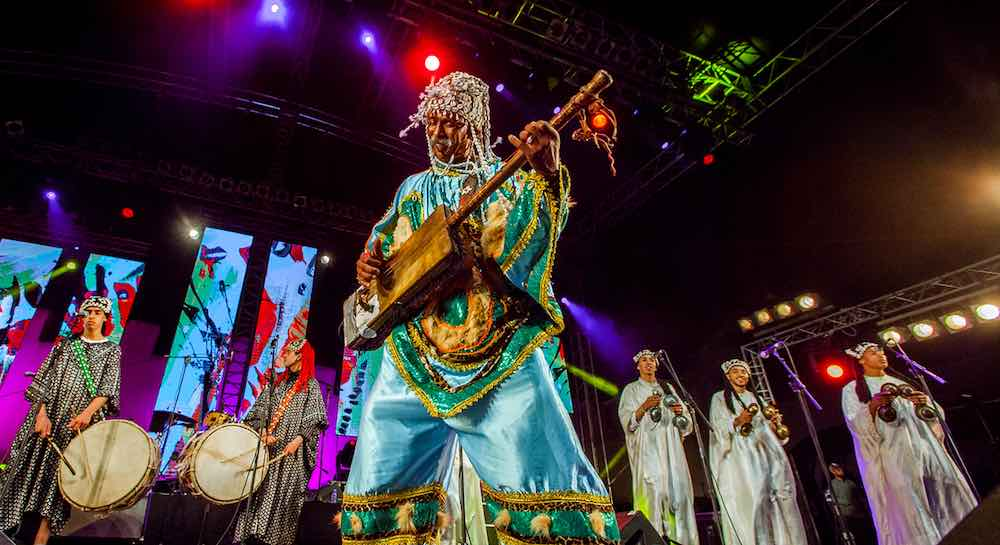
- The guenbri (hajhouj) — A three-string bass lute, carved from wood, with a camel-skin resonating face. Its deep, rhythmic thump is the heartbeat of every piece. The master musician who plays it is called a maâlem and carries the spiritual authority of the tradition.
- The krakeb — Large iron castanets, clapped in pairs, beaten by the choir (the kouyrou). Their metallic clatter creates a hypnotic, driving polyrhythm above the guenbri.
- Call-and-response vocals — The maâlem sings phrases; the choir responds. The lyrics invoke specific spirits (mluk) and tell the stories of the Gnawa ancestral homeland.
The Sound
Gnawa music is fundamentally trance music — its purpose is to shift consciousness, heal, and connect. A lila ceremony begins at sunset and ends at dawn. The rhythm is relentless. The repetition is deliberate. After two hours, you stop listening analytically and start to feel it through the floor and the walls and somewhere deeper than that.
This is why the festival’s legendary midnight fusion sessions — when a Gnawa maâlem sits down with a jazz saxophone player or a blues guitarist who has come from Chicago or New Orleans — produce music unlike anything else. The encounter between two ancient trance traditions (Gnawa and blues both have roots in West African music) creates something genuinely extraordinary.
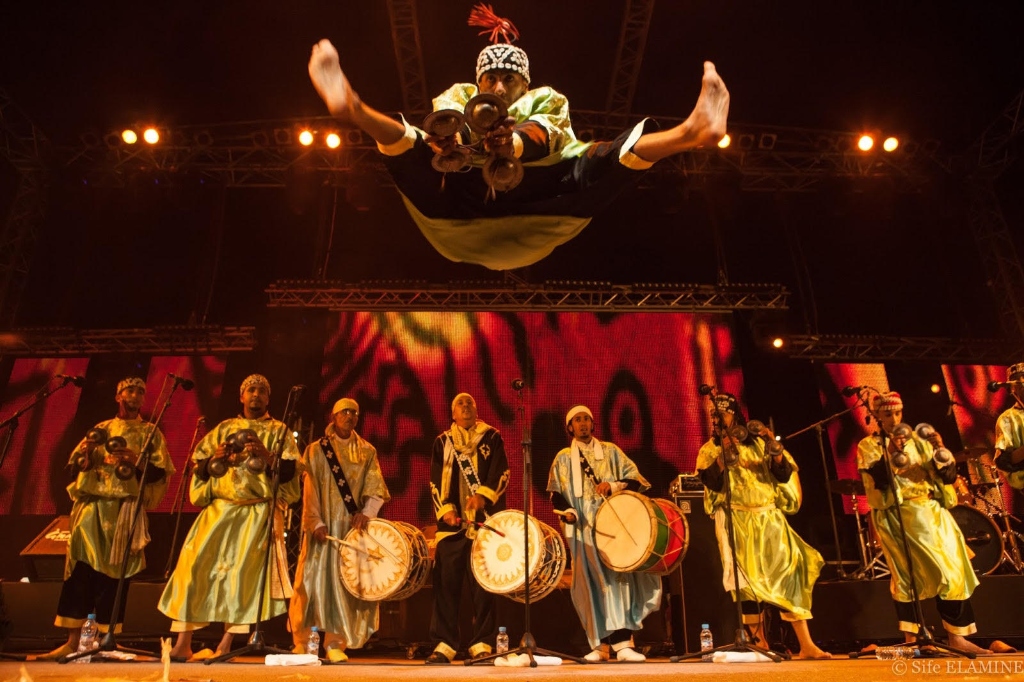
The Festival: Stage by Stage
🎵 Place Moulay Hassan — The Main Stage
The festival’s centrepiece is the free outdoor stage set up in Essaouira’s main square, Place Moulay Hassan, facing the historic médina. The square holds approximately 15,000 people standing, with a VIP seated area in front for 200–400 MAD.
Headliner acts perform here: the most internationally recognised maâlemeen alongside major world music, jazz, and blues collaborators. The 2024 and 2025 editions featured masters from Mali, Senegal, and Morocco alongside European and American jazz musicians. Performances run approximately 8pm–midnight.
Tip: Arrive by 6:30pm to secure a good position if you want to be close to the stage. The square fills quickly after 7pm.
🏰 Skala de la Ville — The Ramparts Stage
Perhaps the festival’s most atmospherically extraordinary venue: the Skala de la Ville, the 18th-century cannon-lined sea ramparts that form Essaouira’s western wall against the Atlantic Ocean. Performances here — smaller-scale, more intimate — take place with the open sea behind the stage and the city’s lanterns glowing behind the audience.
The Skala stage typically features traditional Gnawa ensemble performances — the core tradition without international fusion. For purists, this is the most powerful experience of the festival.
🏖️ The Beach Stage
Essaouira’s 10km Atlantic beach hosts a sunset and early evening stage with a more casual, festival-crowd atmosphere. Moroccan families set up here from early afternoon; the beach stage draws the largest aggregated audience of the festival for its early evening programming.
🌙 The Late-Night Fusion Sessions
The festival’s worst-kept legendary secret. After the official main stages close at midnight, the maâlemeen retreat to venues around the medina — riads, intimate performance spaces, café terraces — and join with invited international musicians for unscheduled, improvised sessions that can run until 4 or 5am.
These are not ticketed. You find them by wandering the medina after midnight and following the sound. A maâlem with a guenbri in a candlelit riad courtyard, playing with a jazz bassist from Paris at 2am, with 30 people sitting in complete silence — this is the experience that people talk about for years.
🎓 Berklee College Collaboration
Since 2010, the Gnawa Festival has partnered with Berklee College of Music (Boston), the world’s premier jazz and music education institution. Berklee students and faculty perform alongside Gnawa masters, and the collaboration produces some of the festival’s most musically sophisticated fusion.
When & How to Book
Accommodation: Act Now
This is the most critical planning point: Essaouira’s accommodation fills 3–6 months before the festival every year. The city has limited riad capacity (perhaps 2,000–3,000 beds in total), and the festival attracts 15–20 times that. By February, the best riads are gone.
Book accommodation by December–January for a June festival at the latest.
Alternatives if Essaouira is full:
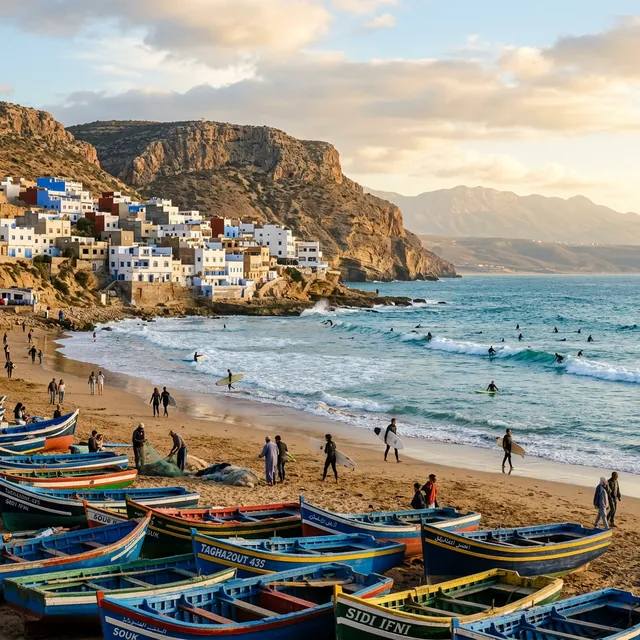
- Sidi Kaouki (15km south of Essaouira) — a small beach village with surf camps; many festival-goers stay here.
- Marrakech (3 hours away) — take a day trip by CTM bus for the evening concerts.
- Agadir (2.5 hours away) — similar option; taxi or bus for the evening.
How to get to Essaouira from Australia
There are no direct flights from Australia to Morocco. The most efficient route for Australians is generally flying via the Middle East (Dubai with Emirates or Doha with Qatar Airways) directly into Casablanca (CMN). From Casablanca, you can either take a connecting domestic flight to Essaouira (ESU) or take the high-speed train to Marrakech, followed by a 3-hour bus ride (CTM or Supratours) to Essaouira.
If you fly into Marrakech Menara Airport (RAK), you are only a 3-hour drive or bus ride from the festival.
| From | Method | Duration | Cost |
|---|---|---|---|
| Marrakech | CTM/Supratours bus | 3 hrs | 90–120 MAD |
| Agadir | Bus or grand taxi | 2–2.5 hrs | 80–100 MAD |
| Casablanca | Bus via Marrakech | 5–6 hrs | 150–200 MAD |
Book CTM (ctm.ma) buses in advance during festival week — they fill completely.
What to Expect: A Day at the Festival
Morning (9am–12pm): Explore the medina at its most peaceful — the festival crowd sleeps late. Buy fresh fish at the harbour, drink coffee at Place Moulay Hassan while the stage crew sets up, browse the pop-up craft stalls and instrument vendors that line the medina during festival week.
Afternoon (12pm–6pm): The beach fills up. Informal workshops and daytime performances run in the medina’s smaller squares. Gnawa instruments and recordings are sold from stalls near the main square. The atmosphere is festive but relaxed.
Evening (6pm–midnight): The main stages come to life. Arrive at Moulay Hassan by 6:30pm for a good position. Move between stages during the evening — the Skala ramparts stage and the main square are 10 minutes apart on foot.
After midnight: Follow the sound through the medina. This is where the festival becomes legend.
Packing & Practical Tips for Australians
- Dress: Essaouira is on the Atlantic and gets a strong evening wind even in June — bring a light jacket or windbreaker for late-night sessions.
- Earplugs: Gnawa music runs until 3–4am. Riad walls are thin. You will be grateful.
- Cash: Festival food and drink stalls are cash-only. ATMs in Essaouira run out of money during festival week — withdraw on arrival.
- The medina at 2am: Perfectly safe. Moroccan families walk home from the festival in large numbers; the atmosphere is celebratory, not menacing.
- Photography: Ask before photographing Gnawa musicians in traditional dress, particularly in intimate settings. Most are welcoming, but courtesy matters.
- Language: French is far more useful than English in Essaouira. A few words of Moroccan Arabic (darija) — shukran (thank you), labas (how are you, fine) — will genuinely delight people.
The Festival’s Cultural Importance
The Gnawa Festival is not just entertainment. It is one of Africa’s most important mechanisms for preserving and transmitting a living cultural tradition that was almost destroyed by centuries of enslavement and cultural suppression.
The festival — and the international attention it has generated — played a direct role in UNESCO’s 2019 recognition of Gnawa as Intangible Cultural Heritage. It has created a global audience for the maâlemeen, given economic sustainability to Gnawa communities in Essaouira and beyond, and established Morocco’s Atlantic coast as a site of genuine world cultural significance.
When you attend, you are not a tourist consuming a show. You are a witness to something very old being kept alive in the modern world.
Read our Essaouira travel guide for more on visiting the city around the festival.