Tangier Travel Guide for Australians: Africa's Gateway City (2026)
Tangier is where Africa and Europe face each other across 14km of sea. A city of writers, artists, and centuries of intrigue — now thriving with new infrastructure and culture. Here's everything Australians need to know.
Introduction
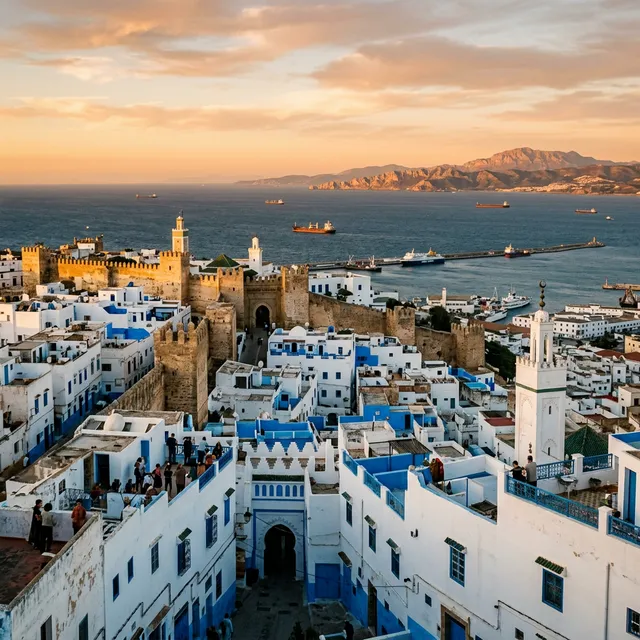
Stand on Tangier’s Cap Spartel promontory and you see it clearly: Spain, shimmering across the water, just 14 kilometres away. This is where the Atlantic Ocean meets the Mediterranean Sea, where Africa meets Europe, and where one of the world’s great layered cities was forged over three thousand years of history.
For decades after Moroccan independence, Tangier was a fading city living on its glorious past — the city that captivated William Burroughs, Tennessee Williams, Paul Bowles, and Henri Matisse. Today it is Morocco’s fastest-growing city, transformed by the Al Boraq high-speed rail link, the Tanger Med port (the largest port in Africa and the Mediterranean), and billions of dirhams of investment that have made Tangier one of North Africa’s most dynamic and visitable destinations.
For Australians, Tangier offers something unique in Morocco: the tangible sensation of being at a geographical and cultural crossroads. On a clear day from the city’s hills, you can see Africa and Europe simultaneously. That feeling never gets old.
Quick Facts: Tangier at a Glance
| 🏙️ Founded | Ancient Phoenician settlement (~5th century BC) |
| 👥 Population | ~1.1 million (2026 estimate) |
| 📍 Location | Northwestern tip of Africa, Strait of Gibraltar |
| 🌉 Claim to fame | Closest point in Africa to Europe — Spain is 14km away |
| 🚄 Transport | Al Boraq high-speed train links to Casablanca in 2h20 |
| 🌡️ Climate | Mediterranean — mild year-round, cooler than southern Morocco |
| ✈️ From AU | ~22 hrs via Dubai/Doha, connect Casablanca then Al Boraq train |
| 🎭 Famous for | Beat Generation writers — Burroughs, Kerouac, Ginsberg, Bowles |
Tangier’s Extraordinary History
Tangier’s story is among the most dramatic of any city in the world. Founded by Phoenician traders over 2,500 years ago, it was subsequently passed through the hands of Carthaginians, Romans (as Tingis, capital of the province of Mauretania Tingitana), Vandals, Byzantines, Arabs, Portuguese, Spanish, and British, before Morocco permanently reclaimed it in 1956.
The most extraordinary chapter came in the 20th century, when Tangier became the world’s only International Zone — governed jointly from 1923 to 1956 by eight nations simultaneously (France, Spain, Britain, USA, Belgium, Netherlands, Portugal, and Italy). No resident paid income tax, currency moved freely, and the city became a magnet for writers, artists, spies, criminals, and exiles of every description.
This is the Tangier that became legendary in literature: Paul Bowles lived here for 52 years, translating Moroccan storytellers and writing his masterpiece The Sheltering Sky. William S. Burroughs wrote Naked Lunch in a medina hotel room, with visits from Allen Ginsberg, Jack Kerouac, and Gregory Corso. Tennessee Williams, Truman Capote, and Henri Matisse all spent time here. The atmosphere of that era — bohemian, transgressive, genuinely international — still echoes through the city’s cafés and lanes.
Top 8 Places to Visit in Tangier
1. ⛩️ The Kasbah & Dar el Makhzen Museum
The kasbah sits at Tangier’s highest point, its whitewashed walls and blue-painted lane offering commanding views across the Strait of Gibraltar to Spain. The original fortifications date from the 15th century, though the kasbah was substantially rebuilt during the Portuguese and later Moroccan periods.
Inside the kasbah, the Dar el Makhzen — a 17th-century sultan’s palace — now houses the Museum of Moroccan Arts, with outstanding collections of Moroccan ceramics, woodwork, metalwork, and textiles. The palace courtyard, with its central fountain and painted cedar ceilings, is one of the most beautiful interiors in northern Morocco.
Practical info: Museum entry 20 MAD (~3 AUD). Closed Tuesdays.
2. 🌊 Cap Spartel & the Caves of Hercules
Drive or taxi 14km southwest of the city to reach Cap Spartel — the dramatic headland where the Atlantic Ocean and the Mediterranean Sea officially meet. The lighthouse here marks one of the world’s great geographical transitions, and the views on a clear day extend to the Spanish coastline.
Just below Cap Spartel, the Caves of Hercules are one of Morocco’s most distinctive natural attractions. These ancient sea caves have been hollowed by both nature and human quarrying over millennia; according to mythology, Hercules rested here after completing his Twelve Labours. The cave’s ocean-facing opening is famously shaped like the continent of Africa — remarkably, it genuinely does look that way.
Practical info: Caves entrance ~35 MAD (~6 AUD). A return taxi from Tangier centre to Cap Spartel and the caves runs approximately 150–200 MAD (25–32 AUD) with waiting time.
3. 🏛️ The American Legation Museum
One of the world’s most unusual museums, the American Legation holds extraordinary historical significance: it was the first diplomatic property acquired by the United States government outside American soil, gifted by Sultan Moulay Slimane to the new American republic in 1821.
The museum chronicles the 200-year relationship between Morocco and the USA (Morocco was the first country to officially recognise American independence in 1777), with exhibits on the International Zone era, Paul Bowles memorabilia, and historical maps of Tangier. The building itself — four interconnected houses in the medina — is a labyrinth of beautiful rooms.
Practical info: Entrance is free. Open Monday–Friday 10am–5pm, Saturday 10am–3pm. Closed Sundays.
4. 📚 The Grand Socco, Petit Socco & Literary Cafés
Tangier’s social life has centred on its twin squares for centuries. The Grand Socco (Place du 9 Avril 1947) is the noisy, energetic gateway to the medina — a junction of trams, market stalls, and café terraces where the bustle of the modern and ancient city collide.
Through the medina arch, the Petit Socco is a quieter square that served as the epicentre of the International Zone’s bohemian life. Café Tingis and Café Central on this square were where Burroughs and Bowles drank coffee and wrote in the 1950s and 60s. Sit at a terrace table in the morning — the atmosphere still carries something of that era.
5. 🚢 Ferry to Tarifa, Spain
This is one of travel’s great experiences and one of Tangier’s best-kept secrets from visitors who don’t know the city: a 35-minute hydrofoil ferry to Tarifa, the southernmost point of Europe. Ferries run several times daily, tickets cost around 25–35 EUR each way, and the experience of departing one continent and arriving on another in under 40 minutes is extraordinary.
From Tarifa, you can explore the spectacular white town, visit the castle, walk the Atlantic beach, or press further north to Seville (1.5 hours by bus) or Gibraltar (30 minutes). Note your Australian passport is required for Spanish entry.
Practical info: Ferries depart from the Tangier Ville port terminal (not the larger Tanger Med port further east). Book through FRS or Baleària ferries online.
6. 🎨 The Tangier Fine Arts Gallery & Ville Nouvelle
The Galerie Delacroix (run by the French Institute) and several smaller commercial galleries in the Ville Nouvelle (new town) exhibit work by contemporary Moroccan and Tangier-based artists. The Ville Nouvelle itself — built during the European administration period — is a fascinating architectural mix of Spanish colonial, French Art Deco, and Moroccan vernacular styles.
Walk along Boulevard Pasteur, stop at the Grand Café de Paris (open since 1928), and understand why artists have been drawn to this city’s light and landscape for over a century.
7. 🏖️ Tangier Bay & Beaches
Tangier’s broad Atlantic bay sweeps south from the port, edged by a boulevard and several kilometres of sandy beach. The northern end near the port is quieter and more local; the southern sections toward the Malabata peninsula are more developed with beach clubs. The beach is urban and busy in summer but genuinely pleasant in spring and autumn.
8. 🌙 The Medina at Night
Tangier’s medina changes character entirely after dark. The tourist pressure dissipates, the lanes are lit by street lamps and café lights, and the real neighbourhood life of the city becomes visible — families in doorways, men playing dominoes in cafés, the smell of mint tea and mechoui from local restaurants. Evening is the best time to experience the medina as a living place rather than a tourist attraction.
Best Areas to Stay in Tangier
| Area | Character | Best For |
|---|---|---|
| Medina | Historic, authentic | Budget travellers, atmosphere seekers |
| Kasbah | Peaceful, elevated views | Boutique riads, photographers |
| Ville Nouvelle | Modern, European-feel | Mid-range hotels, convenience |
| Malabata / Marshan | Residential, sea views | Apartments, longer stays |
Eating in Tangier
Tangier’s food culture blends Moroccan, Andalusian, and European influences in ways you won’t find further south.
- El Morocco Club — A beautifully restored venue in the Ville Nouvelle serving refined Moroccan cuisine; the building’s history dates to the International Zone era.
- Restaurant Hammadi — A medina institution serving excellent traditional Moroccan food at honest prices.
- Le Saveur du Poisson — Fixed-menu seafood feast on Rue de la Liberté; one of Morocco’s most unique dining experiences (no menu — the owner cooks what arrived from the sea that morning).
- Street food at the Grand Socco — Fresh msemen flatbread, meloui, and harira soup at any of the market stalls early morning.
Getting to and Around Tangier
By train: The Al Boraq high-speed train from Casablanca (2h20) is the most comfortable and recommended way to arrive. Book at oncf.ma.
By plane: Tangier Ibn Battuta Airport (TNG) has direct connections from Paris, Madrid, Brussels, and other European cities but no direct flights from Australia — connect through Casablanca.
Around the city: Petit taxis are plentiful and metered. For Cap Spartel and the Caves of Hercules, negotiate a fixed-price return with a driver (150–200 MAD). The city is also walkable between the medina and Ville Nouvelle.
Explore our full Morocco Itineraries for more city guides.