Morocco Surf Coast Guide for Australians (2026)
From Agadir's resort beaches to Taghazout's surf breaks and Imsouane's legendary right-hand wave — Morocco's Atlantic coast is a revelation for Australian beach lovers and surfers.
Introduction
If Marrakech is Morocco’s heartbeat, the Agadir coast is its lungs — wide open, salty, and completely free. This 100-kilometre stretch of Atlantic coastline is one of Africa’s great undiscovered surf destinations, combining world-class waves with extraordinary Berber fishing villages, pristine beaches, and a winter sun climate that Australians immediately recognise: warm, dry, and brilliantly lit.
Agadir itself is Morocco’s most resort-friendly city — completely rebuilt after a catastrophic 1960 earthquake, it is clean, modern, and more accessible than Morocco’s imperial cities. Its beach — 10 kilometres of golden Atlantic sand — rivals anything in Queensland. But the real magic begins 20km north, where the resort infrastructure falls away and the Atlantic coast transforms into a string of legendary surf villages: Taghazout, Tamraght, and the magnificent bay of Imsouane.
For Australian travellers who want sun, ocean, and something genuinely off the tourist trail, this 100km of coast delivers.
Quick Facts at a Glance
| 🏙️ Agadir rebuilt | 1960 earthquake — modern city, no traditional medina |
| 👥 Population | Agadir: ~960,000 | Taghazout: ~3,000 | Imsouane: ~800 |
| 📍 Location | Southern Atlantic coast, 500km south of Casablanca |
| 🌡️ Climate | 300+ sunny days/year — Morocco’s warmest city in winter (avg 20°C) |
| 🏄 Surf season | World-class: October–April. Calm/beginners: June–August |
| ✈️ From AU | ~22 hrs via Dubai or Doha into Agadir Al Massira Airport (AGA) |
| 🛏️ Best for | Beach holidays, surfing, winter sun, relaxed Morocco intro |
| 💰 Currency | 1 AUD ≈ 6.2 MAD (2026) |
Agadir: Morocco’s Sun Coast Capital
The Beach
Agadir’s beach is the city’s defining feature — and for good reason. The Agadir Corniche runs for nearly 10 kilometres along a south-facing bay, sheltered from the prevailing north swell, making it one of Morocco’s calmest and most swimmable beaches. The water is clean, lifeguards patrol in summer, and the beach is wide enough that even at peak season it never feels overcrowded.
A broad promenade runs the length of the beach with cafés, juice bars, and restaurants. Beach clubs with sunbeds and umbrellas operate in summer. The overall atmosphere is noticeably more relaxed than a European resort — fewer crowds, much cheaper food and drinks, and spectacular light year-round.
Agadir Kasbah
At the northern end of the beach, perched on a 236-metre hilltop, the ruins of the Agadir Kasbah watch over the city. The original fortification dated from the 16th century; it was almost entirely destroyed in the 1960 earthquake. What remains are the hilltop walls (rebuilt) and the extraordinary 360-degree views: to the south, the modern city and bay; to the north, the crumpled Atlantic coastline stretching toward Taghazout; to the east, the first escarpment of the Anti-Atlas mountains.
A taxi to the kasbah from the city costs around 80–100 MAD return. Free entry.
Souk El Had
Agadir’s famous weekly market — one of the largest in southern Morocco — operates every Sunday near the port. Locals shop here for everything from spices and argan oil to clothing, electronics, and fresh produce. It is a genuine local market rather than a tourist souk, and prices reflect this.
Taghazout: The Surf Village
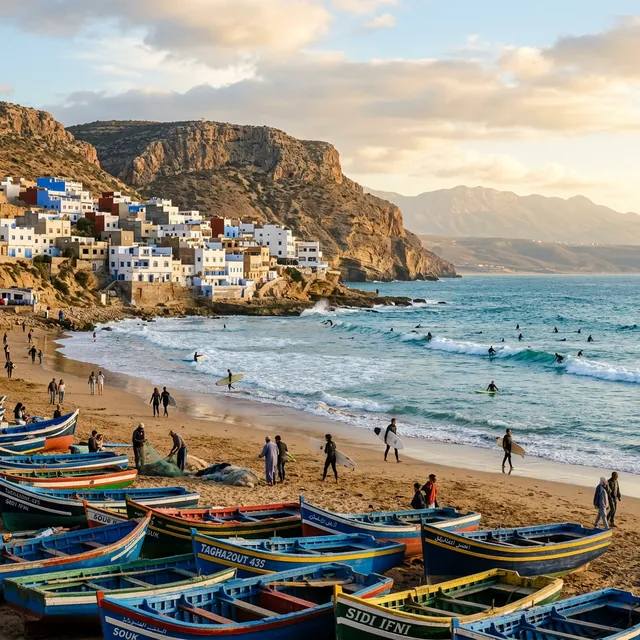
Twenty kilometres north of Agadir’s beach resort sprawl, the world changes. Taghazout is a small Berber fishing village that became, quietly and without resort development, one of the world’s most beloved surf destinations. Its reputation rests on a cluster of consistent right-hand reef breaks that work best from October to April, attracting surfers from Europe, Australia, and North America year-round.
The Waves
The Taghazout area hosts several surf breaks within 5km of the village:
- Taghazout Bay (Hash Point) — The most famous. A long right-hand reef break, best at 2–4 feet, perfect for intermediates. Works on northwest and west swells.
- Anchor Point — The premium break, 2km north of the village. Long, powerful right-hander that can produce rides over 300m on a good swell. For experienced surfers (4+ feet).
- Boilers — Hollow, fast right-hand reef. Intermediate to advanced.
- Panoramas — Just north of the village, a more forgiving right-hander ideal for beginners and beginners improving.
- Banana Point — A mellow beach break 3km south, suitable for absolute beginners.
Surf Schools & Camps
Taghazout has over 30 surf schools and retreat camps. Beginner lessons run 400–500 MAD per day (65–80 AUD) including board, wetsuit, instruction, and usually lunch. Week-long packages with accommodation start from around 3,500–5,000 MAD (560–800 AUD) all-inclusive. Book ahead in peak season (December–February).
Beyond Surfing
Even for non-surfers, Taghazout is worth a half-day visit from Agadir. The village is small and atmospheric: a cluster of whitewashed Berber houses on a rocky headland, cats sleeping in the sun, fishing boats on the beach, and the sound of Arabic music from open café doors. The main terrace cafés overlooking the bay serve excellent grilled fish and fresh-pressed argan oil for dipping bread.
The Thursday market in Taghazout is a small but genuine weekly souk where local Berber women sell produce, argan oil, honey, and handicrafts.
Imsouane: The Hidden Bay
If Taghazout is world-famous, Imsouane is whispered about. Sixty kilometres north of Agadir, tucked behind a headland at the mouth of a small river, Imsouane Bay is one of the most visually stunning and technically impressive surf locations in Africa.
The Wave
The bay is almost perfectly circular. On the right day, at the right tide, the wave at Imsouane peels across the entire bay for up to 800 metres — one of the longest right-hand waves in Africa. It is a gentle, forgiving wave (not powerful — it breaks on a sandy bottom) which makes it excellent for all levels, and those extremely long rides make it unlike anything most surfers will have experienced before.
The Village
Imsouane is not a resort. It is a small Berber fishing village with a couple of basic surf camps, a handful of simple restaurants, a working harbour where the morning catch comes in at 7am, and almost no tourist infrastructure. The lack of development is, at this point, the point. It is one of the last genuinely unmodernised surf villages on the Morocco coast.
Accommodation in Imsouane is basic: surf camps with shared dorms or simple private rooms (150–250 MAD/night). There is no luxury hotel. This is intentional — people who go to Imsouane are not looking for comfort; they are looking for the bay.
Imsouane or Taghazout — Which Should You Choose?
This is the most common dilemma for Australian surfers planning their Moroccan trip. While they are only 40km apart, they offer completely different experiences:
Choose Taghazout if:
- You want variety. Taghazout has a cluster of different breaks (Anchor Point, Hash Point, Panoramas) within a 5km radius.
- You prefer a more developed surf town vibe with dozens of cafés, surf shops, yoga retreats, and a lively backpacker scene.
- You are an intermediate to advanced surfer chasing the powerful, world-class right-handers at Anchor Point.
- You want easy access to Agadir (20 mins away) for supermarkets or day trips.
Choose Imsouane if:
- You want the longest ride of your life. The wave at “The Bay” is legendary for peeling up to 800 metres on a perfect day.
- You are a beginner to intermediate surfer looking for a soft, forgiving, sandy-bottom wave.
- You prefer a deeply isolated, purely authentic Moroccan fishing village with almost zero commercial tourist infrastructure.
- You ride a longboard. Imsouane is a longboarder’s ultimate paradise.
If you have a week or more, we highly recommend splitting your time between both to get the best of both worlds.
Immouzer des Ida Outanane: Day Trip into the Atlas
One hour east of Agadir in the foothills of the Anti-Atlas mountains, the Immouzer des Ida Outanane canyon leads to natural waterfalls that flow in spring (November–April) and dry to a trickle in summer. The drive through the argan forest and then into dramatic limestone canyon is itself worth the trip. The waterfall site has a small café and picnic area.
A return taxi or organised day trip from Agadir costs around 300–400 MAD (50–65 AUD). Best visited between January and April.
Practical Guide for Australians
Getting to Agadir
Flights: Agadir Al Massira Airport (AGA) receives direct flights from various European cities. From Australia, the best connections are via Dubai (Emirates) to Casablanca, then a domestic connection to Agadir (1 hour, operated by RAM or Air Arabia Maroc). Alternatively, fly to Casablanca and take the bus south (8 hours).
Note: Direct flights are not available from Australia to Agadir — all itineraries involve a Casablanca connection.
Getting Between Agadir, Taghazout, and Imsouane
| Route | Method | Duration | Cost |
|---|---|---|---|
| Agadir → Taghazout | Taxi (grand/petit) | 20 min | 70–100 MAD |
| Agadir → Imsouane | Taxi (negotiated) | 50–60 min | 150–200 MAD |
| Taghazout → Imsouane | Taxi | 35–40 min | 80–120 MAD |
Renting a car in Agadir (from ~350 MAD/day, 56 AUD) gives maximum flexibility for the coastline.
Where to Stay
| Location | Best For | Price Range |
|---|---|---|
| Agadir (Corniche) | Beach hotels, families, seniors | 400–1,500 MAD/night |
| Taghazout village | Surf camps, backpackers | 150–400 MAD/night |
| Taghazout surf lodges | Mid-range surf retreats | 400–900 MAD/night |
| Imsouane | Budget surf camps | 120–250 MAD/night |
What to Eat on the Coast
The Agadir coast is one of Morocco’s best seafood destinations — the Atlantic here is extraordinarily productive, and the fishing industry supplies some of the finest sardines, sea bass, red mullet, and squid in the Mediterranean world.
- Grilled sardines — The local staple. Fresh sardines open-grilled over charcoal with chermoula, served with bread and argan oil. Cost: 30–50 MAD per plate (5–8 AUD).
- Tagine of fish — Slow-cooked in clay with preserved lemon, olives, and chermoula herb paste.
- Shark tagine — A local speciality in Agadir, using the small Atlantic sharks caught by local fishermen.
- Argan oil with bread — The region is the world’s only source of argan, and eating fresh bread dipped in raw culinary argan oil is one of the great simple pleasures of southern Morocco.
- Amlou — A spread made from argan oil, almonds, and honey, served for breakfast with bread. Rich, nutty, and addictive.
Explore our full Experiences section for more Morocco travel guides.